Reflect on what you’ve learned and your accomplishments on your Technovation journey
Write your Learning Journey response for your submission
These are the activities for this lesson:
REFLECT
Think back to where you and your team started and everything that has happened as you’ve worked to get your Technovation project working and completed.
You’ve come a long way!
The judges want to understand what you’ve accomplished too.
Tell them all about the highs and lows of your project – what new skills you have gained, and what obstacles you have overcome to make your project what it is today.
The Learning Journey now includes three parts.
- What you learned and how you overcame technical and non-technical challenges. (100 words)
- How your team decided what information you gathered for your project was legitimate. (max 100 words)
Think about the research you did on your problem. Or how you learned to code your app. What sources did you use. Did you check the information was accurate? Did you use AI to help you. How did you check the information? - A bibliography of resources used for your project. (unlimited word count)
Judges want to know where you got your information and where you got help for your project. The template provides some prompts to help you get started.
As part of your writeup about what you learned and overcame challenges, you will include 2-6 pictures that help to explain the process for the judges.
Remember, a picture is worth 1000 words!
You can include screenshots of early sketches and prototypes. You may also include user feedback you received and changes you made to your project as a result.
EXAMPLES
Below are some examples of Learning Journeys from previous Technovation teams. These examples just include part 1, what was learned and how the team overcame obstacles.
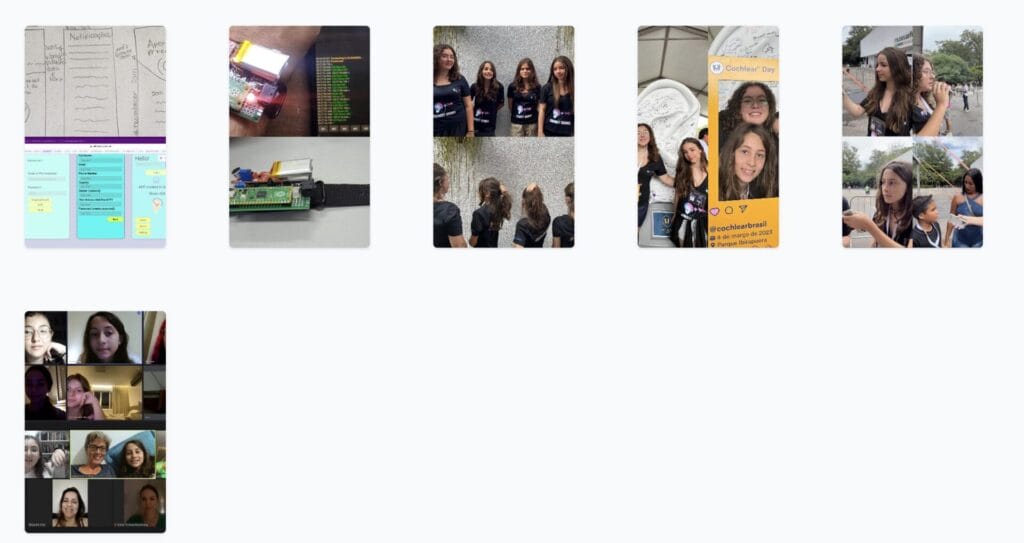
Our journey started in November 2022 when 4 hearing impaired cochlear implant users, the Bionics Girls, decided to enhance the APP developed by Katarina on the Connected Girls team at Technovation 2022 in beginner division. The 1st version of the APP, developed with APP Inventor and Arduino, allowed the registration of sounds and when recognized in the user’s external environment, it made the cell phone vibrate.
For 2023, our goal was to add a bracelet that vibrates and flashes when detecting the previously recorded sound, alerting the user of possible danger or warning. We learned how to use the Thunkable platform that allows us to generate APPs for Android and iOS. And we also learned about the Raspberry Pico board, which is smaller, which allows for a better fit on the bracelet, in addition to being programmed in Python, offering more features. It was challenging to connect the bracelet to the APP and also to talk about our disability on social media, even knowing that this is important for self-acceptance and to motivate other disabled people to feel the same way. We are doing our best for the APP to make a difference in the lives of all hearing impaired people.
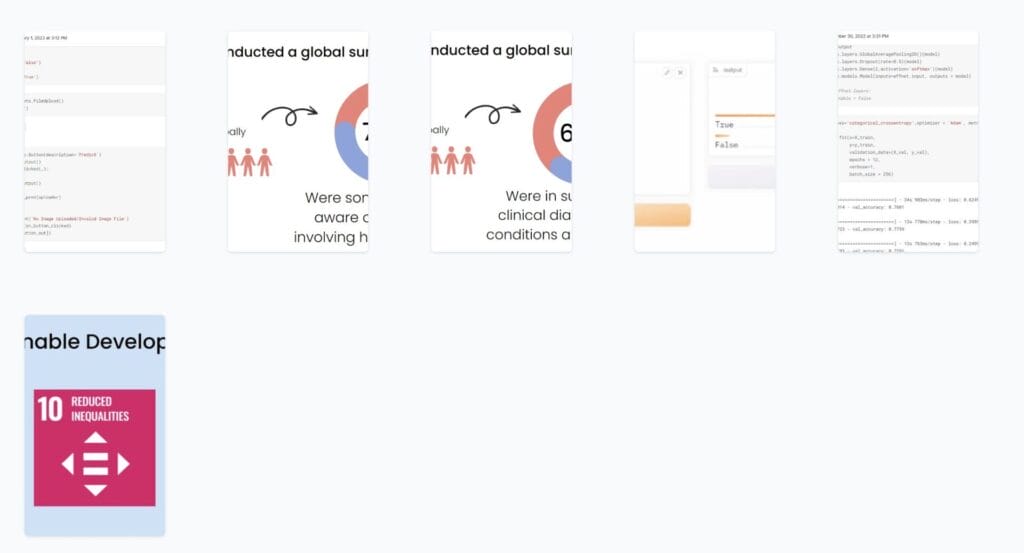
At the start of our journey in building Project HeartScope, we were new to the classification systems and AI applications within healthcare. We began our AI discovery process by sitting on 3-hour long calls developing image classification replicates on Kaggle, where we learned commonly used techniques within image classification and the different neural networks used for maximizing accuracy.
There were moments during our journey when we felt discouraged, as the errors produced by the computer seemed impossible to fix. How could we solve a problem when we couldn’t even understand the problem itself? However, we realized the importance of taking breaks during our calls to approach the issue with a fresh perspective, which proved to be effective in overcoming many of the bugs we encountered. We also consulted a Brain Tumour MRI Classification project we replicated on Kaggle for guidance (author: Jay) for uploading data, and building our first model base.
In summary, we have realized that finding joy in the learning process and being passionate about the innovation we were creating has been a driving force to keep us motivated. We also realized that a big part of success is making mistakes, and taking the unconventional path.
TEAM REFLECTION
Take a few moments together to look back and discuss how you and your project have changed. For example:
How did you change the project or your ideas after doing user research or testing?
How did you change the project or your ideas after doing competitor research?
What new technical skills have you learned this season?
How has your team grown this season?
Did you have to work together to overcome any challenges?
Have you improved as a team throughout the season? How?
- What were the important resources you used to help you get over the finish line?
- What did you learn about trusting sources and AI tools?
ACTIVITY: LEARNING JOURNEY
Reflect as a team
- Use the questions above to generate discussion around what you have learned and overcome.
- Use the template provided to fill out the different parts of the learning journey.
- Select 2-6 images you think will help tell the story. They should be meaningful and highlight team accomplishments.
- When submitting, you will cut and paste the first two parts of your learning journey.
- For the bibliography, you will copy and paste from the template into a separate document that you will upload to the Technovation platform.
REFLECTION
Writing the Learning Journey is, in itself, a reflection of your entire Technovation season. Give yourselves one more pat on the back for all you’ve accomplished over the past several months.
And get ready, next week you will submit your project!