- Learn what a Lean Canvas is and why it is a useful tool for startups
- Understand the key sections of a Lean Canvas and how they relate to your business idea
- Synthesize insights from problem validation, solution identification, and market research into a comprehensive Lean Canvas
Lean Canvas
What is a Lean Canvas?
A Lean Canvas is a one-page tool that helps you map out your business idea. Think of it as a snapshot of your venture. It lets you see the most important parts of your idea all in one place, helping you spot gaps, test assumptions, and prioritize what matters most. It is flexible and easy to update, so it evolves as your ideas grow and improve.
Using a Lean Canvas, you will be able to clearly identify the problem you are solving, who your customers are, and how your solution fits into their lives. The best part is that it is a hands-on way to explore your ideas, test assumptions, and figure out what works while keeping your focus simple and clear.
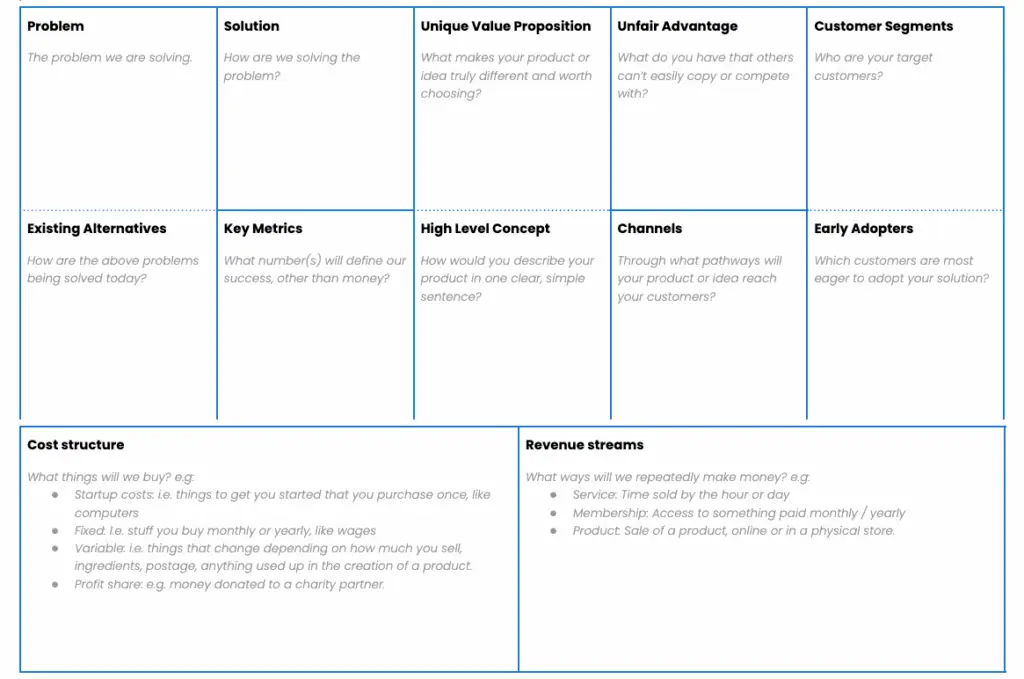
Take a moment to look at the canvas above. Notice which sections seem straightforward and which might take more thought, and think about why. You should see several sections that look familiar. That’s because you have already done a lot of research that has prepared you to fill out the Lean Canvas. Your problem refinement, solution identification, and market research signify a good portion of the Lean Canvas contents.
Don’t worry if some boxes seem tricky because that’s exactly what the canvas is for. It is meant to evolve with your ideas and help you make sense of them as you go.
Why Use a Lean Canvas
The Lean Canvas helps you get your idea out of your head and into the real world by focusing only on the most important pieces. Instead of writing pages of plans and details, you get to quickly map out your idea on one page.
Created by Ash Maurya for startups, the Lean Canvas helps founders focus on assumptions, risks, and the most critical elements of a business idea. It is especially useful for testing ideas and learning quickly before investing too much time or money, something that startups have in limited supply.
This single-page format keeps your ideas clear and focused. It makes it easier not only for you to understand your own business but also to explain it quickly and clearly to others, like potential partners or customers. It also helps you identify gaps in your idea, get feedback from others, and see which parts need the most attention.
Plus, since it’s easy to update, the Lean Canvas grows with your business, helping you stay on track every step of the way. Keep in mind the goal is not to write every detail perfectly. Focus on the most important and impactful information and you’ll get the most out of this tool.
What are the parts of the Lean Canvas?
Let’s dive into what each part of the Lean Canvas is and why they’re important. We’ll also be including examples of each section that are inspired by Be My Eyes, an app that connects blind or low vision users who want assistance, with volunteers and companies across the world, through live video and AI.
While Ash Maurya now says there is no particular order to fill out the boxes, we’ll order them according to his most recent suggestion. But certainly fill out your lean canvas in the way that feels most natural to you.
1. Customer Segments
What it asks: Who exactly are you solving this problem for?
Why it matters: Clearly defining customer segments helps you tailor your solution and outreach to their needs. Understanding your primary users ensures your product stays relevant and lets you focus resources on those most likely to benefit and adopt it.
Example: Be My Eyes serves blind and visually impaired individuals who need assistance with everyday tasks, as well as sighted volunteers who are willing to provide live help through the app. Both groups are essential to the platform’s functionality and success.
2. Early Adopters
What it asks: Which customers are most eager to adopt your solution?
Why it matters: Early adopters are the first users most likely to engage with your solution and offer valuable feedback. They help test assumptions, spread awareness, and validate if your product solves the problem. Knowing who they are lets you focus early efforts on those most willing to try and support it.
Example: Be My Eyes’ early adopters included blind and visually impaired individuals who were active technology users and motivated to try new tools for independence, as well as sighted volunteers eager to contribute to a community-driven solution.
3. Problem
What it asks: What problem are you solving for your customers?
Why it matters: Your business should solve a real problem people want fixed.
Example: Blind and visually impaired people often struggle with tasks that rely on visual cues, like checking expiration dates, identifying colors, or reading labels. Without immediate access to help from others, routine activities can become frustrating, inefficient, or even unsafe.
4. Existing Alternatives
What it asks: What other options do customers have now to solve this problem?
Why it matters: Understanding alternatives helps you identify gaps, improve current solutions, and design something truly valuable.
Example: Blind or visually impaired people often rely on friends or family, ask strangers in public, or use limited-function assistive devices. While these offer some support, they can be unreliable, inconvenient, or slow—leaving room for a more immediate, scalable solution like the Be My Eyes app.
5. Unique Value Proposition
What it asks: What makes your business special or different from others? Why should customers choose you?
Why it matters: Your unique value proposition shows what sets your solution apart and why it matters to customers. A clear value proposition helps users see why your product is worth using and stand out from alternatives. It should be concise, specific, and tied directly to the problem you’re solving.
Example: Be My Eyes provides instant, reliable help for blind and visually impaired users by connecting them with a global network of volunteers. Unlike traditional assistance methods, it is on-demand, scalable, and community-driven, making everyday tasks easier and more accessible.
6. High Level Concept
What it asks: How would you describe your product in one clear, simple sentence?
Why it matters: The high-level concept gives a quick, clear idea of what your product does. It helps explain your idea to users, partners, or investors in just a few words. A strong concept captures your solution’s essence and value without getting lost in detail.
Example: Be My Eyes is an app that connects blind and visually impaired people with volunteers who can provide live visual assistance for everyday tasks.
7. Solution
What it asks: How will your business solve the problem? What product or service will you offer?
Why it matters: Your solution should directly address the core problem your customers face, not just add extra features. Focus on what truly matters to your users and design your solution based on insights from research, interviews, or observations.
Example: Be My Eyes is a mobile app that connects blind and visually impaired users with sighted volunteers through live video calls. Volunteers assist with everyday tasks like reading labels, checking expiration dates, or identifying colors, offering immediate and reliable help.
8. Unfair Advantage
What it asks: What do you have that others cannot easily copy or compete with?
Why it matters: Your unfair advantage gives your solution a lasting edge over alternatives—like a unique network, exclusive partnerships, specialized knowledge, or an engaged community. Identifying it helps you focus on what makes your business defensible and hard to replicate. While your UVP shows users what sets you apart, your unfair advantage tells competitors why copying you isn’t worth it.
Example: Be My Eyes has a global volunteer network that’s hard for competitors to replicate. Its strong community and established infrastructure give it a consistent edge in delivering reliable, on-demand assistance.
9. Revenue Streams
What it asks: How will your business make money?
Why it matters: Identifying revenue streams ensures your business can sustain operations and grow. Knowing how you’ll generate income supports strategic decisions on pricing, partnerships, and scaling. Even with a social mission, a clear revenue plan is key to long-term viability. We’ll explore this further later, but it’s worth considering initial ideas now.
Example: Be My Eyes is free for users, but earns revenue through partnerships with accessibility-focused organizations, sponsorships, and premium services that boost engagement. These streams help the platform stay sustainable while fulfilling its social mission.
10. Cost Structure
What it asks: What are the main costs involved in running your business?
Why it matters: Understanding your costs helps you plan a sustainable budget and run your business efficiently. Costs include one-time expenses like app development or equipment, and recurring ones like hosting, marketing, or staff. Knowing your cost structure supports informed decisions on pricing, resource use, and growth. We’ll explore this further in a later lesson.
Example: Be My Eyes’ costs include app development and maintenance, server hosting, marketing to attract new users and volunteers, and partnerships with organizations that support blind and visually impaired communities.
11. Key Metrics
What it asks: What numbers will you track to see if your business is succeeding?
Why it matters: Understanding alternatives helps you identify gaps, improve current solutions, and design something truly valuable.
Example: Be My Eyes might track metrics like active users, successful assistance sessions, response times, and satisfaction ratings. These figures show how well the app connects volunteers with users and whether it’s improving daily experiences.
12. Channels
What it asks: How will your product or idea reach your customers?
Why it matters: Channels are how you connect with target users and deliver your solution. Choosing effective ones ensures your product reaches the right people efficiently and helps you track and repeat successful outreach. Understanding your channels lets you focus resources on strategies that truly drive user engagement. This might require further research, but for now, include your thoughts based on your user interactions.
Example: Be My Eyes reaches users via app stores, partnerships with organizations for the blind, social media, and referrals. Tracking downloads, active users, and volunteer engagement helps measure which channels work best.
From Research To Canvas
You have done a lot of research and investigation in the past 3 units. The Lean Canvas is a great way to synthesize all the information into a concise document. Below are ways your previous work connects to the sections of the Lean Canvas:
Look at each unit below to see the different lean canvas sections it connects to.
Unit 3 – Understanding the Problem
- Refined problem statement → Problem
- Stakeholder pain points → Problem
- Current workarounds → Existing Alternatives
- User identification & characteristics → Customer Segments / Early Adopters
Unit 4 – Identifying Your Solution
- Top solution idea → Solution / High-Level Concept
- How solution solves the problem → Solution
Unit 6 – Market Research
- Competitor Research
- Main competitors → Existing Alternatives
- Competitor gaps → Unique Value Proposition
- Differentiation → UVP / Unfair Advantage
- Industry Benchmarking
- Key metrics tracked → Key Metrics
- Pricing benchmarks → Cost Structure / Revenue Streams
- Social Listening
- Social media channels → Channels / Early Adopters
- Pain points (from social listening) → Problem
- SWOT Analysis
- Strengths → UVP / Unfair Advantage
- Weaknesses → Cost Structure
- Opportunities → Unfair Advantage / Segments / Channels
- Threats → Existing Alternatives / Cost Structure / Revenue Streams
Final – Lean Canvas
Everything Comes Together:
All your research—from defining the problem to understanding competitors and validating your solution—fills each box of the Lean Canvas with clear, evidence-based insights.
Click on each icon to see which previous lessons connects to that section.
Unit 3 (Problem Refinement and Understanding Your Audience):
- Refined problem statement
- Stakeholder pain points
Unit 6 (Market Research):
- Social Listening
Unit 4 (Solution Identification):
- Your top solution idea
- How solution addresses the problem
Unit 6 (Market Research):
- Competitor Research ->competitor gaps, differentiation
- SWOT Analysis -> Strengths
Unit 6 (Market Research):
- Competitor Research -> differentiation
- SWOT Analysis -> Strengths, Opportunities
Unit 3 (Problem Refinement and Understanding Your Audience):
- User identification, characteristics
Unit 6 (Market Research):
- SWOT Analysis -> Opportunities
Unit 3 (Problem Refinement and Understanding Your Audience):
- Current workarounds
Unit 6 (Market Research):
- Competitor Research
- SWOT Analysis -> Threats
Unit 6 (Market Research):
- Industry Benchmarking
Unit 4 (Solution Identification):
- Top solution idea
Unit 3 (Problem Refinement and Understanding Your Audience):
- User characteristics
Unit 6 (Market Research):
- Social Listening
- SWOT Analysis -> Opportunities
Unit 3 (Problem Refinement and Understanding Your Audience):
- User characteristics
Unit 6 (Market Research):
- Social Listening
- SWOT Analysis -> Opportunities
Unit 6 (Market Research):
- Industry Benchmarking -> Pricing
- SWOT Analysis -> Weaknesses, Threats
Unit 6 (Market Research):
- Industry Benchmarking -> Pricing
- SWOT Analysis -> Threats
What Makes a Good Lean Canvas?
As you work on filling out your Lean Canvas, keep in mind that this document is a snapshot in time of your business. It is a one page snapshot, not a detailed plan. It helps you identify both a strategic plan and assumptions you have that will need to be tested.
Elements of a good lean canvas:
LANGUAGE IS CONCISE
No more than 1-3 short bullet points, or 2-3 sentences
CONTENT IS SPECIFIC
Use concrete details, not vague generalities. Stay away from genAI tools as they often can produce generic language
PROBLEM & SOLUTION ARE ALIGNED
The solution must clearly address the problem described.
ASSUMPTIONS ARE VISIBLE
Uncertain areas are acknowledged rather than disguised as facts (good canvases highlight what still needs to be tested).
ACTIVITY 1
Fill In Your Lean Canvas
Estimated Time: 45-60 minutes
Now that you’ve read the lesson, it’s time to put your ideas into action by filling out your own Lean Canvas.
Before You Start:
Review your work from Units 3-5. The Lean Canvas should flow naturally from your previous work—you’re synthesizing, not starting over. If a section feels difficult, it might signal an area where you need more research or validation.
Use the From Research to Canvas section above to connect your research to the appropriate section(s).
Here’s a suggested order on how to fill it out. Remember that whatever feels natural is the best way for you to fill out your lean canvas.
1. Start with Customer Segments and Early Adopters
- Specify who benefits most and who will try your product first.
- Be as concrete as possible about demographics, behaviors, or motivations.
2. Move to the Problem and Existing Alternatives
- Identify the main problems your users face and how they currently address them.
- Focus on the top 1–3 pain points that matter most.
2. Define your Unique Value Proposition, High Level Concept, then Solution and Unfair Advantage
- Describe your core solution and why it is valuable.
- Summarize your idea in one simple sentence for quick understanding.
4. Outline Cost Structure, Revenue Streams, Key Metrics, and Channels
Draft how you will generate revenue and manage costs, measure success, and reach users,
Reflection
Now that you’ve been introduced to the Lean Canvas, take a moment to reflect on what you’ve learned and how it applies to your own ideas. Remember, your Lean Canvas is a living document that’s meant to evolve as you test assumptions, gather feedback, and refine your venture. Return to it often through your development process:

Easiest Part
Biggest Challenge
Audience
Key Insight
Assumptions
Additional Resources
Here’s a video showing how to apply Uber to the Lean Canvas tool:
You can find more info about crafting a lean canvas here.