Get ideas and templates to take your solutions to the next level
SDG 16 POWER SOLUTIONS
There are many innovative ways to use technology to solve SDG 16 issues. Below are some examples to inspire you.
X Abuse
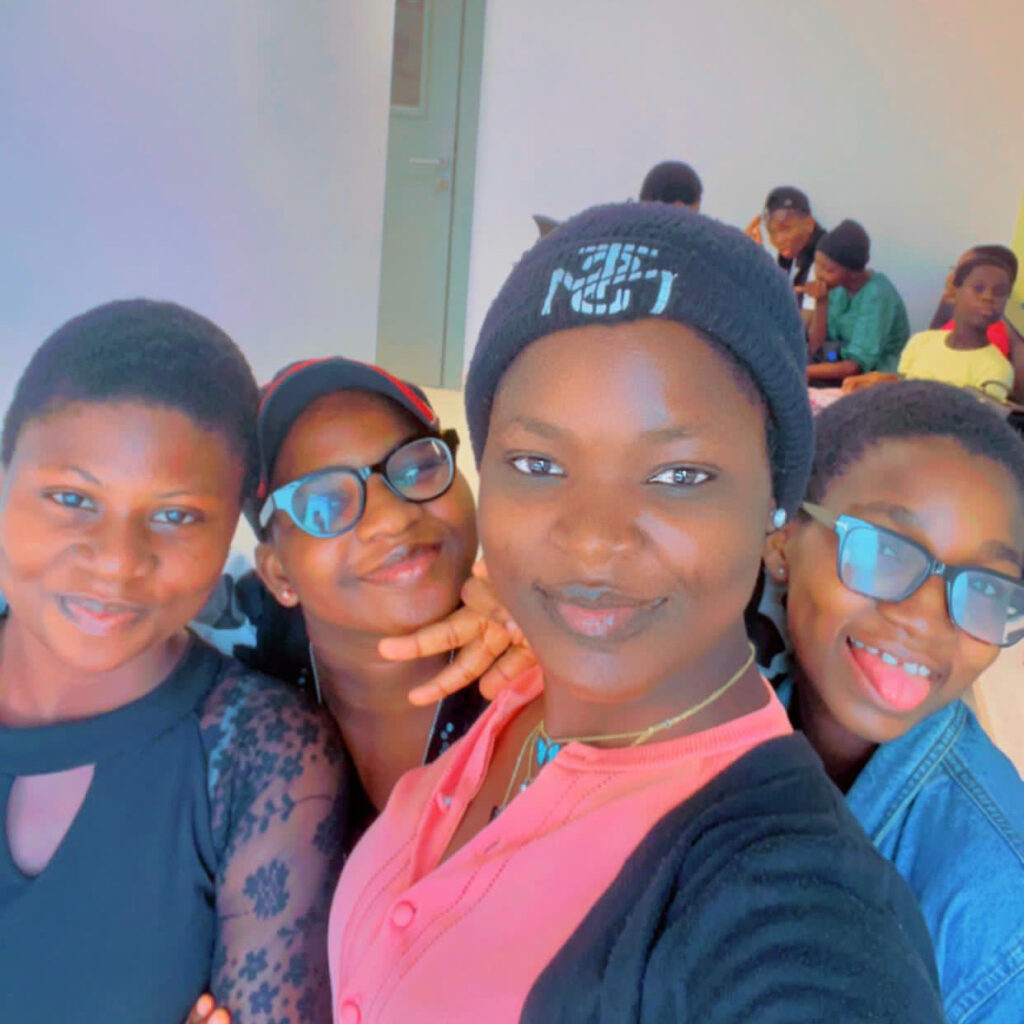
One excellent example is provided by Brio Girls, a Technovation Girls team from Nigeria who built an app X Abuse. X Abuse is an app that is a lifeline for minors in crisis. This innovative platform offers confidential reporting, connecting victims with local authorities and support services. Unique features include reporting for others and motivational support. Empowering children to seek help and break free from danger, the app aims to end the cycle of violence, ensuring the safety and well-being of our most vulnerable. Our vision is a world where every child is free from harm, heard, and able to thrive.
Here is the pitch video for X Abuse.
Abayi Norah and Okoro Onyekachi shared their thoughts on many aspects of working on their project over the 2024 and 2025 Technovation seasons.
Introductions
How did you decide to work on this problem?
What excited you as you started the project, and what were you concerned about?
How did you learn to code your app?
How did your mentor help you with your project?
How did your app change over the course of the project?
How did you test your app with users and what was the feedback?
What impact do you think your app could have on your community?
What was it like working on a team of four?
What could be some next steps for the app?
Are there plans to continue working on the app?
How did you stay motivated to continue the project?
What are your personal plans for the future?
What advice do you have for Technovation Girls?
What about girls who might be unsure about joining Technovation Girls?
JusticePath
One of our Technovation alumnae, Anika Jha, has built an app called JusticePath, to help users know their rights and stand up for themselves confidently and safely.
I’m Anika Jha, a high school sophomore, and I describe myself as a learning enthusiast and aspiring polymath. My heart lives on any type of physics, especially astro, quantum, and particle physics. From developing award-winning apps like cHHange – It’s Normal and Quake It Off to building a CubeSat prototype to writing a published 25-page scientific report detailing the potential machinery and aspects of the first manned mission to Mars, I love applying science to real-world (and hypothetical) problems. As a TED-Ed speaker, Diana Award recipient, author, and Technovation Girls international winner + student ambassador, I strive to inspire others to dream bigger. I recently won a global Rube Goldberg competition by designing an inclusive STEM-themed playground for children (which will now be built), and I hope it will encourage youth to find joy in learning.
TUTORIAL
Anika’s tutorial takes you through the entire process, from ideation, to defining your user, to the MVP, and finally to coding the app.
The app itself is an example app, with the framework to show you how to use a chatbot API in a Streamlit app to enable that feature in your app.
In addition she shows you how to create a JSON file that includes information that can then be pulled into the app using a Search feature.
You can take her framework and expand on it in your own way to target social justice issues … or any issue really!
Here are a few more solutions to spark ideas for you for SDG 16. Click each tab to see some possible features and what coding components you could use to build a similar app.
CIVICS101
This civics engagement app can be a learning tool as well as a way for young people to engage in local issues.
Users can enter a profile with basic information to test out how policies will affect them
You can use TextBoxes for the user to enter the information and then Stored Variables or TInyDB to store the information locally on the phone.
Calculator to show how a particular policy affects you
You can keep a database of some known issues in the community that the user can choose from with a ListView Based on the user profile and the policy, information about how they will personally be affected will be displayed. You can use Graphs, Images, and Labels to provide the information for the user.
Provide details on local issues, with information on both sides of the issue, voting dates, and potential actions
You can use a Location Sensor to detect location of user, and then provide that to a government or news organization API that will provide the necessary information. If an API is not available, you can create your own database with the necessary information for the app.
Simulated debate with a chatbot
You can use a Chatbot to take the role of an official or community member taking the opposite view of the policy. This can give the user practice with communicating their point of view on the policy.
SeeMyCity
This map-based app would allow users to explore the different government buildings in their city, to explore their services, budgets, events, etc.
Government buildings would be displayed on a map
You can use the Map component with Markers to designate each building, using appropriate icons. Clicking a marker would display basic information about that building. The information can be stored in an online database that can be updated as things change.
Color Coded HeatMaps
Buildings and sections of town could appear color coded to depict the budget amount. You can use map Circles or FeatureCollections to outline areas. They could display budget information when clicked.
Chat/Forum with Local Government Officials
You could partner with the local government officials to create a forum where people can ask questions and get answers. You can use a cloud database to store the chats and then a ListView to display the content.
Notifications of local meetings and elections
You can use a cloud database or Web API to track city events and elections, then use Notifications to let users know when they are happening and where.
iResolve
This app would allow users to resolve local disputes with the help of trained community mediators, along with AI.
Users take photos to document and log a dispute
You can use the Camera and TextBoxes to let users submit a dispute.
AI modeling to classify and suggest resolutions
Use a machine learning model that is trained on historical disputes in the area. The model can classify the logged dispute - for example, noise complaint, pet issues - and then display possible resolutions based on previous complaints and how they were resolved.
Mediator Network
Work with the local community to create a network of trained mediators. There can be an online database of people with their location and contact information. These volunteers can be notified automatically with Texts when there is an unresolved dispute.
Users can schedule mediation meetings
You can use a DatePicker and TimePicker to set up meetings with mediators and dispute parties. All people can be notified of the meeting automatically via Text.
We're updating this site to reflect our new direction. Technovation's refreshed brand and broadened mission are live at technovation.org. Your curriculum and competition resources stay right here.
See what's new
SDG 16 Power Solutions
NOTE: You will use the MachineLearningForKids website.
You will have two options to use the website:
Get your teacher or mentor to sign up and they can create an account for you.
You can save your project, but the Scratch project won’t be saved. If you want to keep the Scratch project, save it to your computer.
Try without an account by clicking Get Started, then clicking Try it Now.
If you Try it Now without an account, you can do the exercise, but cannot save it.
Login
Accessing this course requires a login. Please enter your credentials below!